Q&A with Natalie G. Adams on The Cheer Reader
This Q&A with Natalie G. Adams, editor of The Cheer Reader: Inside an American Institution, was originally published by the University of Texas Press on October 6, 2026. It is republished here with permission. Read the original Q&A on the UT Press website.
Natalie G. Adams is a professor of Social and Cultural Studies in Education at the University of Alabama. She is the coauthor of Cheerleader! An American Icon and Just Trying to Have School: The Struggle for Desegregation in Mississippi, and the co-editor of Geographies of Girlhood: Identities In-Between.
When most people hear the word “cheerleader,” a very specific image comes to mind—usually involving pom-poms, megaphones, and high school sidelines. What’s the biggest gap between how the public views cheerleading and the reality of its history?
When people think of cheerleaders, they may think of them as the prettiest, most popular girls at their high school or college. Or they may think of them as rather vapid, shallow, clueless girls who really aren’t very interesting. Some people may think of them as super athletes who just haven’t gotten the respect they deserve. Some may think of the Dallas Cowboys Cheerleaders in their sexy uniforms and white go-go boots. Regardless of the exact image, most people think of cheerleaders as girls or young women. They are typically very surprised to discover that the first cheerleaders were men, and for 60 years, cheerleading was primarily a male-only or male-dominated activity. It wasn’t until World War II that young women took over cheerleading, and by the 1950s the complete feminization of cheerleading had taken place.
Also, many cheerleaders in the US and globally are not on the sidelines at all. In the early 1990s, a new type of cheerleading emerged called All Star cheerleading, sometimes referred to as competitive cheer or show cheer. All Star cheer is not affiliated with any school or university. Rather All Star teams compete for the private gyms where they are housed. They do not perform any of the typical roles of cheer, like cheering for the team on the field or serving as an ambassador for their school. Gabi Butler, one of the stars of the Netflix hit, Cheer, never cheered a day of her life for a high school. Rather, she cheered for Top Gun All Stars and California All Stars. A recent development in cheer is the Professional Cheer League, which debuted in 2026 with four teams. Gabi Butler competes in the PCL on Miami Metal.
How have men’s roles in cheer evolved over time, and what does that tell us about changing ideas of masculinity?
The earliest cheerleaders, dating back to 1869, were young men on Ivy League campuses. Their popularity grew so that by the early 1900s male cheerleaders were a ubiquitous part of most college campuses. In our book, we have some great pictures from Oregon State University of those early male cheerleaders.
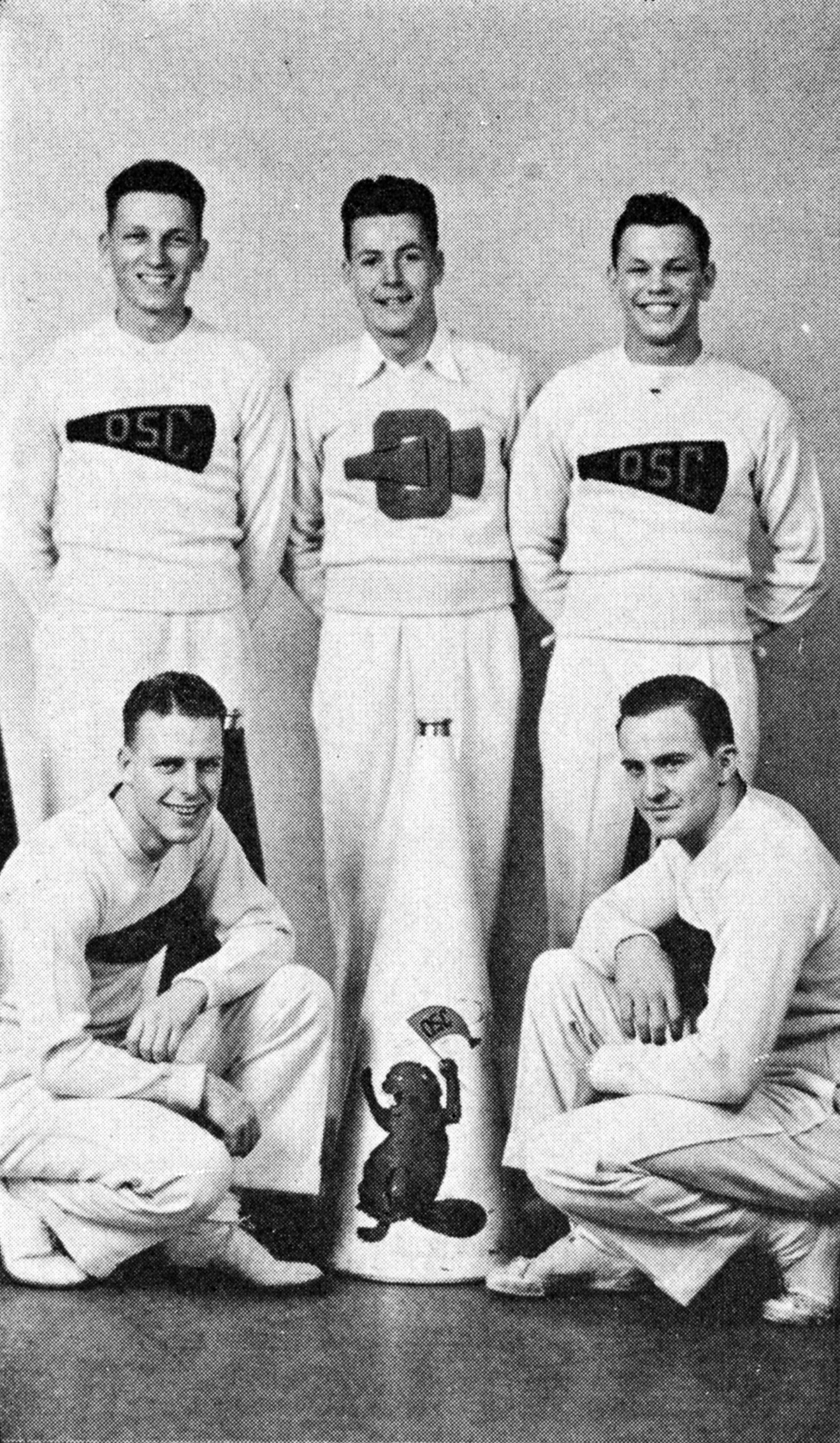
Figure 1.04
These male cheerleaders were campus leaders, often from the Greek system. They were considered very manly men. Cheerleading was a high-status activity, and often the cheerleaders for the football team played for their college’s basketball or baseball teams. The respect given to these early male cheerleaders as symbols of masculinity is apparent in a 1911 article in The Nation: “the reputation of having been a valiant cheer-leader is one of the most valuable things a boy can take away from college. As a title to promotion in professional or public life, it ranks hardly second to that of being a quarterback.” They were – as one historian wrote – the epitome of the BMOC (Big Man on Campus). These early male cheerleaders were being prepared to assume positions of power as leaders in the new Industrial order.
By the 1960s, cheerleading was almost exclusively female at the high school level, although male cheerleaders could still be found on college campuses. But as the activity became associated with women and femininity, men who cheered were no longer considered the epitome of masculinity. In fact, quite the opposite: their masculinity and heterosexuality were questioned. Manly men play sports – sissy or gay men cheer. In other words, cheerleading was no longer congruent with masculine norms and ideals of the day.
Men returned to cheer with the introduction of All Star cheer teams and competitive coed collegiate teams. However, they entered a very different terrain than that of their earlier cheer brothers. If a guy wanted to cheer, he knew his masculinity and sexuality would be questioned. For some men, that was fine; but others developed strategies to emphasize their masculinity, like spending lots of time in the gym building muscle and emphasizing their injuries as proof of their athleticism and masculinity. They developed quick comebacks when their heterosexualized masculinity was questioned, like “You throw a one-pound ball. I hold a 110-pound woman in the air” or “I’m not the one showering with guys every day. I’m touching girls in places you only dream about.”
The cheer industry itself developed an unwritten rule to downplay the stereotype that only gay men cheer. For example, male cheerleaders are typically discouraged from dancing or performing jumps, like toe touches. They don’t even have to smile. As one male cheerleader told us, “The guy’s the frame; the woman is the piece of art.” At football and basketball games, you’ll often see male cheerleaders standing behind their dancing female counterparts, either holding the megaphone, doing straight-arm movements, or throwing t-shirts into the crowd. Their role on the team is to be the source of power and strength during stunting and the protector who ensures the girls they’ve thrown in the air make it safely down. The women cheerleaders are meant to be the object of the gaze. In this sense, coed cheerleading adheres to traditional gender norms and the gendered division of labor.
There is some wiggle room in All Star and competitive cheer for presenting multiple forms of masculinities – some quite different from traditional norms. Men are often the star tumblers, thus the center of attention, rather in the background. They sometimes dance and convey exaggerated facial expressions, like the women. And a few are now wearing some bling, bedazzles, and sequins on their uniforms.
One of the most popular cast members of Cheer was La’Darius Marshall, who was openly queer. On the series, he shared his experiences of being bullied as a teen by family and friends for being gay and being a cheerleader. But by the time we see him on the series, La’Darius is a muscular, tough guy. He sometimes makes the young women on the team cry because of his harsh criticism. He is aggressive both on and off the field. So, in many ways, he presents as very traditionally masculine. But there is also another side of La’Darius that is over-the-top expressive. He loves to dance, tumble, perform, and be the center of attention; he smiles really, really big, and makes his sexuality known. I think many people see cheer – at least for Black queer men – as a much more open space for performing multiple types of masculinities, and that has resonated with many men – both straight and queer. Unfortunately, queer women in cheer are much less visible.
During school desegregation in the 1950s–1970s, cheerleading became unexpectedly political. How did Black and Brown cheerleaders use cheer as a space for representation and civil rights activism?
The position of cheerleader in segregated schools conferred status on Black and Brown cheerleaders, akin to that of white girls. They were considered the pretty, popular, successful girls. As Amira Rose Davis and Paulina Serrano note in chapter 2 of the book, in the Black newspapers of the day, they were often described as the “beauties of the game.” However, when schools began to desegregate, Black athletes had a much easier time integrating their newly desegregated high school sports teams than did Black girls integrating the cheer squad. The exclusion of Black and Brown girls from cheerleading was accomplished by both implicit and explicit policies and practices. For example, specific racial quotas about the composition of the team or criteria stating one must wear her hair in a ponytail or perform a roundoff and a split.
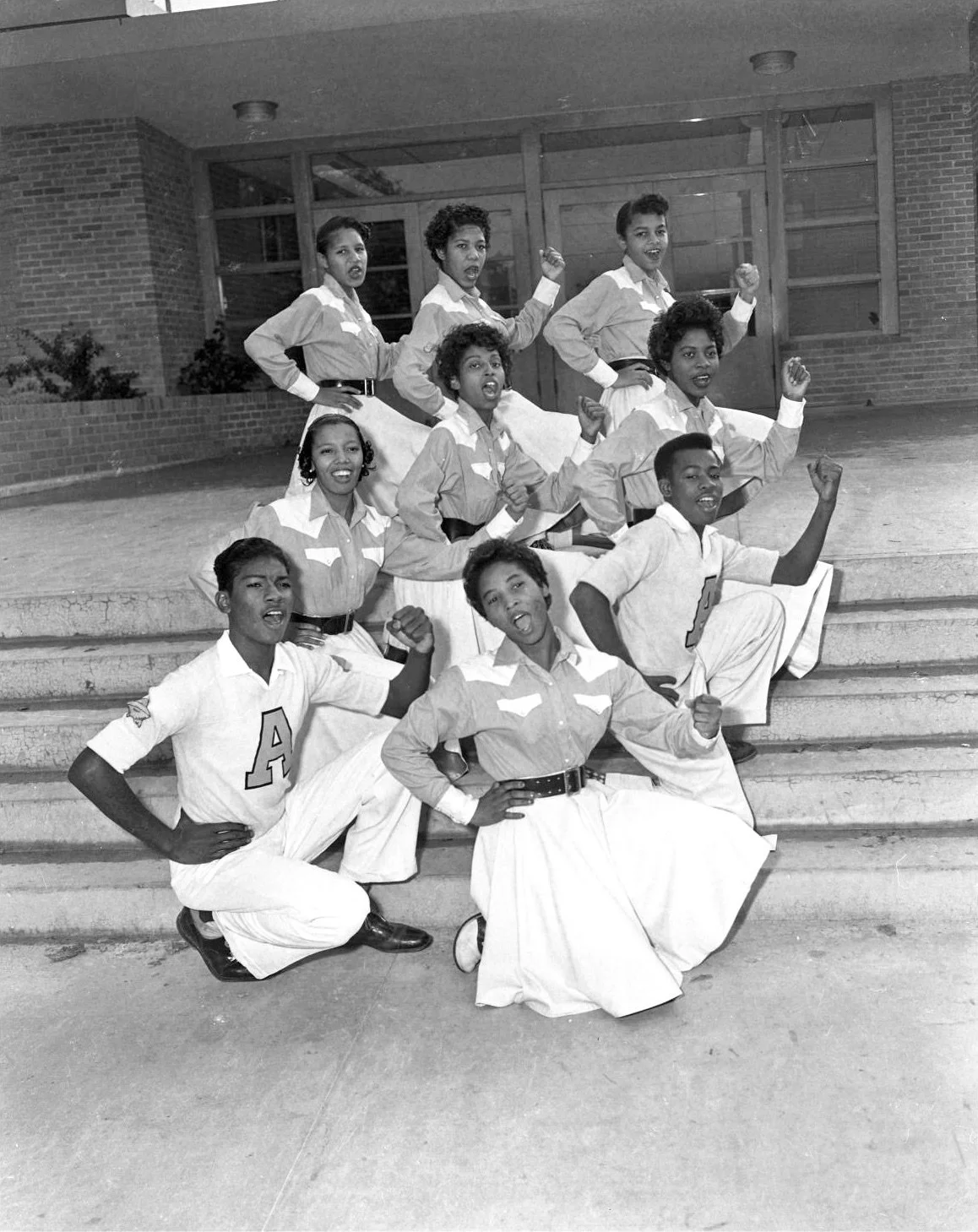
Figure 2.02
Throughout the country, you see time and time again, protests staged in response to Black girls trying out for cheerleading and not being selected for the team. Black students mobilized over cheer. In the book, Paulina Serrano relates the story of a young Chicana woman, Diana Palacios, who was not selected as a cheerleader at Crystal City High School in Crystal City, Texas. The school had an unwritten policy that 3 of the 4 girls selected for cheerleader would be Anglo. Diana spearheaded an organized protest that eventually led to a school walkout that lasted over a month. This walkout was heralded as one of the most successful student protests because it resulted in substantive changes in school policy, curriculum, and the leadership of the city itself. One year later, the Crystal City cheer team was comprised of all Chicana girls.
Black and Brown young women used the sidelines to bring attention to the continued racist practices and policies that were meant to keep them second-class citizens in their schools and, by extension, the nation. Their exclusion was not simply about denying individual girls the opportunity to engage in a high-status activity that was fun. The protests were a demand to be acknowledged as worthy and deserving of the All-American, girl-next-door moniker. The stories of exclusion and protests involving cheerleading during school desegregation are important narratives to be told in the fight for civil rights.
Despite extreme physical demands and high injury rates, cheerleading still isn’t formally recognized as a sport under Title IX. Why has its focus on performance and appearance made legitimacy such a battle?
The debate about “is cheerleading a sport” has been around for 30 years. And the advocates for both sides have been quite vocal. Right now, those who oppose the sports designation are winning. In the book, we talk about the complexities of that debate and the unusual allies. But, primarily, opponents of cheer being a sport cite concerns about Title IX, which was meant to move girls off the sidelines to the fields. These opponents are concerned that high schools and colleges will eliminate traditional women’s sports and replace them with cheerleading. That’s exactly what happened at Quinnipiac University when they eliminated their volleyball team and replaced it with cheer. A lawsuit was filed; a federal judge eventually ruled cheer could not count as a sport under Title IX guidelines and ordered the school to reinstate its women’s volleyball team.
To date, the National Collegiate Athletic Association (NCAA) has yet to designate cheer a sport despite the obvious athleticism of cheerleaders. However, two forms of cheerleading – acro and STUNT – are now designated as NCAA emerging sports, so we shall see how that plays out in the future. The format of those sports does not look like the traditional competitive cheer, and only females are permitted to participate.
So why, despite the athleticism of its participants, its high rate of injuries, and public perceptions that cheer is a sport (as apparent in how often the “sport of cheer” is referenced in the media), is cheer not an NCAA-sanctioned sport? Two reasons: its complicated history with Title IX and the feminist movement, which leads to the second reason: its continued entanglement with hypersexuality and femininity. It’s hard to deny, as you watch a two-and-a-half-minute competition routine, complete with harrowing stunts and tumbling, that cheerleading is not an athletic endeavor. But the fact that the female cheerleaders tossed in the air 15 feet are doing so in short skirts with ribbons and bows presents a roadblock in cheer’s fight for sports legitimacy. It’s why when you go to an acro or STUNT event, it looks quite different from a typical cheer competition. There are no short skirts, no bows, no excessive makeup, no exaggerated facials, no aesthetic performances. It is an intentional attempt to distance itself from the short skirts and booty bumps so frequently associated with cheer.
When Netflix’s Cheer dropped in early 2020, it became an instant global sensation. Why do you think that docuseries struck such a huge chord, and how did its reception influence this book?
I don’t think anyone, including Greg Whiteley, the director and executive producer, expected Cheer to be as popular as it was, but it struck a chord with the American public. Old and young, rich and poor, Black and white, and gay, straight, and queer Americans embraced Cheer. But it’s important to remember where we were in January 2020 to understand its popularity. We were in the middle of a presidential impeachment trial. Trust in institutions of all kinds was at an all-time low. We were embroiled in vitriolic, often vicious, debates over immigration, reproductive rights, race relations, and climate change. And as we know now, we were on the cusp of what would become the worldwide coronavirus pandemic. Cheer seemed to be just what a country suffering the loss of national unity needed by capturing, perhaps nostalgically, the America we longed for—one personified by cheerleading itself: strength during crisis, unity around common causes, optimism about the future, and a country where everyone belongs. What was probably even more surprising was the popularity of Cheer globally. Soon after its release, I began to receive phone calls from journalists in France, England, Spain, and Japan who seemed obsessed with American cheerleading, particularly Coach Monica Aldama and her scrappy squad, who are featured in the docuseries as serious athletes who persevere through pain and heartbreak to win their school’s 14th national championship. It made me realize that it wasn’t just Americans who needed a big cheerleading hug—the rest of the world did as well.
Being on Cheer as the cheer historian and cultural pundit thrust me back into the world of cheerleading as I was answering phone calls daily from reporters, documentarians, TV producers, and cheerleaders themselves (one cheerleader called to tell me thanks. For some reason, he thought I was the director and producer!). I had co-authored a book 20 years earlier called Cheerleader: An American Icon, so my co-author, Pam Bettis, and I began to sketch out a follow-up to that book called Cheer: An American Obsession. We were riding pretty high from the success of Cheer and decided this was a good time to capitalize on the cheer love-fest that was going on. However, less than two months later, my husband received a very dire cancer diagnosis, and on March 1, 2020, we left our home in Tuscaloosa to travel to the Cleveland Clinic for him to receive treatment. Things did not go as we hoped, and it was a pretty hard time personally, so I abandoned the book project. When my husband passed away in 2021, I returned to writing the book as a way to force me back into the world. By that time, Pam had retired and decided she didn’t want to pursue any more academic writing, so I shifted gears a bit and decided to write an edited book. I reached out to the few scholars who had written about cheerleading in some capacity and received a very positive response. This became The Cheer Reader: Inside an American Institution, which brings together an interdisciplinary group of scholars to answer the question: Why does cheer matter?
Read The Cheer Reader: Inside an American Institution
The Cheer Reader: Inside an American Institution, edited by Natalie G. Adams, is out now from the University of Texas Press. Bringing together scholars and cheerleaders from across disciplines and experiences, the collection explores cheerleading as sport, culture, identity, labor, media, and a uniquely American institution.